
The Great Migration in Tanzania: Two Key Seasons: Calving vs. Mara River Crossing
Few wildlife spectacles on Earth rival the sheer scale, drama, and emotion of the Great Wildebeest Migration across Tanzania’s Serengeti and into Kenya’s Maasai Mara. Every year, more than 1.5 million wildebeests, along with hundreds of thousands of zebras and gazelles, traverse a circular route driven by rainfall and the promise of fresh green grass for grazing.
But not all moments of the migration are the same. Two of the most compelling—and very different—phases are the calving season in southern Serengeti and the iconic Mara River crossings in the north. Each offers a distinct experience, both in terms of wildlife behavior and emotional impact.
Annual route of the Great Wildebeest Migration across Tanzania and Kenya, highlighting calving grounds and key river crossings.
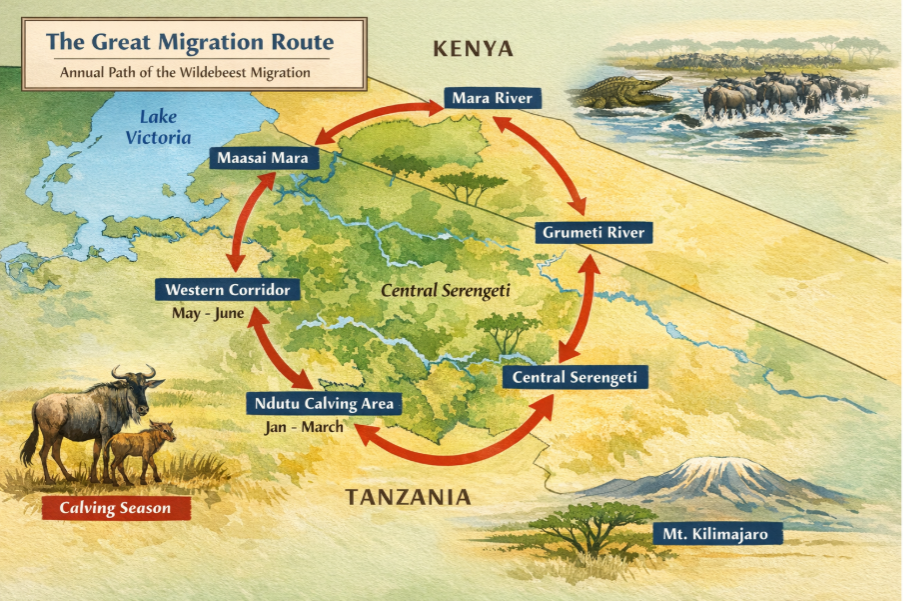
Calving Season (January – March): Life Begins on the Southern Plains
The migration begins its most delicate and life-affirming phase in the Ndutu region and southern Serengeti plains, where the herds congregate during the rainy season.
What Happens During Calving Season?
In a remarkable evolutionary strategy, wildebeests synchronize births to overwhelm predators. Over a span of just a few weeks, nearly 500,000 calves are born, often within a 2–3-week window.
What Makes This Phase Extraordinary?
1. A Birth Explosion
· Thousands of calves are born daily.
· Newborns can stand and run within minutes—a critical survival trait.
2. Predator Activity at Its Peak
· Lions, cheetahs, hyenas, and even jackals are highly active.
· The abundance of vulnerable calves creates dramatic predator-prey encounters.
3. Gentle Landscapes
· Open grasslands stretch endlessly under dramatic skies.
· The setting is calmer visually compared to the chaos of river crossings.
Emotional Tone
Calving season is often described as hopeful, tender, and raw. Yes, there is predation—but there is also new life everywhere you look. It’s a time when resilience and renewal dominate the story. It’s simply amazing and it happens in Tanzania!
Best For Travelers Who Want:
· Intimate wildlife viewing
· Photography of newborn animals
· Less crowded safari experiences
· A deeper, more emotional connection to nature
Mara River Crossing (July – October): Survival Against All Odds
As the dry season grips the Serengeti, the herds push north toward greener pastures. This brings them to one of the most perilous obstacles in their journey: the Mara River. The Mara River offers scenic wildlife viewing with Crocodiles often lining the sides or taking a swim. Rhinos are often seen along with birds fishing for their dinners.
What Makes the Mara River so perilous?
Wildebeests must cross crocodile-infested waters, navigate steep banks, and face sheer panic within the herd. Their migration takes them across to the other side to reach Kenya.
What Makes This Phase Iconic?
1. High-Stakes Drama
· Massive herds gather, hesitate, then suddenly surge into the river.
· Crossings can happen within minutes—or take hours of buildup.
· It’s a wait and see adventure and no one knows when they will begin to bolt across
2. Crocodile Attacks
· Nile crocodiles lie in wait, sometimes over 15 feet long.
· Many animals don’t survive, making the crossing both breathtaking and sobering.
3. Chaos and Confusion
· Wildebeests may trample each other or drown in the crush.
· Calves and weaker animals are particularly vulnerable.
Emotional Tone
The Mara River crossing is intense, chaotic, and unforgettable. It’s nature at its most unforgiving—where instinct, fear, and survival collide in a dramatic spectacle. It is the most sought after African safari experience and it happens here in Tanzania!
Best For Travelers Who Want:
· Action-packed wildlife scenes
· Bucket-list photography moments
· The “classic” Great Migration experience seen in documentaries
· Adrenaline and unpredictability
Final Thought
The beauty of the Great Migration is that it is not a single event—but a continuous cycle of life, death, and movement. The calving season and river crossings are simply different chapters in one of nature’s greatest stories.
If you’re lucky enough to experience either, you’re not just watching wildlife—you’re witnessing the rhythm of the wild, as it has unfolded for thousands of years across the plains of Tanzania.